




Dean of Student Life Jordan Church said the meetings were founded in hopes of fostering unity.
“We gather not simply to hold events, but to strengthen the bonds that make our community vibrant and resilient,” Church said. “We believe that shared experiences forge bonds, regardless of the content of the events. When students, faculty and staff come together, we create shared experiences that build trust, foster belonging and remind us that education extends far beyond the classroom walls.”
Fiona Tseng ’28 said she appreciates the thought put into the events.
“I like the new events, particularly the sound bath and therapy dogs,” Tseng said. “ That was a great way to not only bond with others, but also to collectively calm from all the stressors around us. I have gotten closer with many of my peers, especially those in my dean group.”
Student Leaders for Inclusion Diversity and Equity (SLIDE) leader and Community Time Committee member Reb Limerick said, so far, the events are going as planned.
“I was part of the group that was coming up with what an assembly for Community Time would look like,” Limerick said. “As a visual arts teacher, I wanted to make sure there was an arts feature each month because I knew that it would be a great way to bring in different artistic mediums in student voices into our community. I also wanted to make sure that SLIDE was featured.”
Evan Kim ’27 said while she enjoys the built-in opportunity to connect with classmates, she does feel the events can add stress during busy times of year.
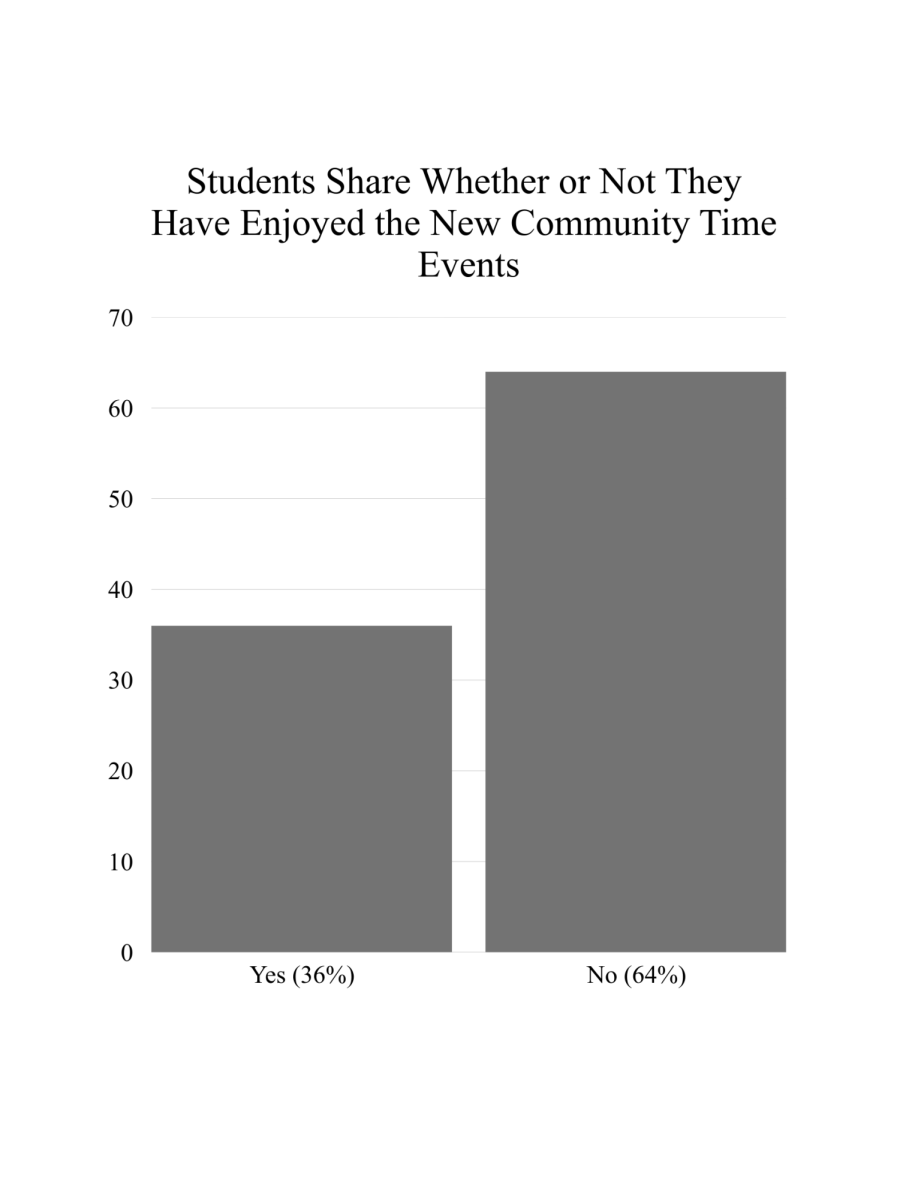
“The events are fun and they bring the community together,” Kim said. “I love being able to see all my friends and spend time with them or other people I don’t get to see often. They bring everyone together, but they do take up a lot of free time. Personally, I like the events and it’s nice to have time to not think about testing, work and other things, but there are times where the community time events are right before a test or on a really busy day where I could use the free time.”
Upper School Dean Sarah Miller said community time is important to create connections beyond surface-level interactions.
“Your sense of the people around you and how you treat your peers is stronger in a place where no one is unknown or anonymous to you,” Miller said. “ Maybe it feels forced to students, but when you’re not forced to have time with your entire community all the time, people can kind of be faceless or nameless.”
Community Council member Hudson Lake ’26 said a main goal of the events is to create a more supportive school environment.
“The primary purpose of the community time events is to strengthen the school community,” Lake said. “Part of that entails putting on events such as the past week’s community time when we [were packing food for the homeless]. We hope events like that build empathy. Typically, organizing the events consists of working with Mr. Church, Wormholdt, and other administrators to bring in organizations and sort of logistics.”
Physics teacher Yanni Vourgourakis said the student body’s reaction is encouraging.
“The assemblies have worked surprisingly well,” Vourgourakis said. “I’m a little surprised by how much buy in there has been. Specifically the singing was very good and people enjoyed it.”
Lulu Aridi ’27 said while she admires the idea of the events, sometimes the execution is not ideal.
“I do support the idea of building a stronger community within the school and raising school spirit, and while some events are really fun, oftentimes it feels like we’re playing games or watching videos when lots of us are worried about homework and other things we could be doing with the free time,” Aridi said.
Evan Daneshrad ’27said the best way to foster connection is to allow students to do so themselves.
“ A better use of the time used for the community events would be to give students free time to interact .” Daneshrad said. “Usually kids are on the quad talking, interacting and playing games.”
Community Time committee leader Ivy Wang ’26 said the events speak to the committee’s larger and more long term goal of fostering belonging.
“There has been some complaining over losing time but I see how community times are going so far and being very effective for the years to come once people get used to it,” Wang said. “The school, historically, has been a place where students focus on individual paths which are fueled by competition and isolation, but I see community time rewriting that. There is a bigger picture we are trying to achieve and I wish for those with pessimism to approach events with an open mind.”