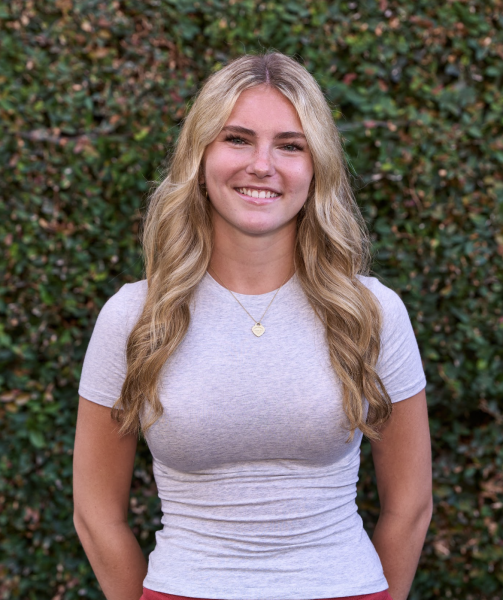








In the middle of ballet class, Summer Park ’27 and a few of her fellow dancers were suddenly yanked out of line and removed from their four-hour rehearsal while the rest of the young ballerinas continued prancing to the piano’s tune. Directors, teachers and parent volunteers circled the alienated girls with clipboards and tape measures, recording their exact height, weight and measurements in front of their peers. Park said the traumatic experience happened before major auditions and quickly became a normalized practice and an early lesson in how closely a young girl’s body would be watched.
Park said the expectations that many young dancers grow up with are shaped by the close monitoring of their bodies.
“They would get rulers and measure your body in front of everyone,” Park said. “We had to openly talk about our weight. It was humiliating.”
Park said, although she was able to overcome the experience, these little moments snowballed into an uneasy atmosphere of constant comparison within the dance room.
“Fortunately for myself, throughout my life, I’ve been able to love my body and accept myself for who I am,” Park said. “But, I do know that millions of people my age struggle with constant comparison and body dysmorphia. In the dance room there are literally mirrors all over the walls, so looking at other people and comparing yourself is inevitable.”
Dancers report costume fittings as the number one time they feel judged for their bodies, according to a 2022 Dancer Mental Health Survey, and only 7% of ballet companies regularly purchase costumes above a size two, according to a U.S. Costuming Survey. Park said the costuming contributes to the culture of comparison in ballet.
“For shows like The Nutcracker, there’s a specific role that everyone wants, like the Sugar Plum Fairy or Clara,” Park said. “The majority of ballet studios reuse costumes over and over again. You can’t really change up the sizes. It’s one specific size, a size zero.”
Wrestler Nelson LaBombard ’27 said athletes face similar pressure to be a certain weight.
“The ideal wrestling body is very lean during season,” LaBombard said. “Typically, 6–10% body fat is considered what my dad calls ‘fighting shape.’ Weight classes definitely affect the way that I think about my body, and there’s always stress around how much weight I have to lose.”
As many as 62% of dancers experience symptoms of body dysmorphia, far higher than the national teen average, according to the National Eating Disorders Association. More than 75% of dancers report being told to lose weight by a teacher, coach or director, and 68% of dancers say they have been excluded from a role, costume or choreography because of their body, according to the Journal of Dance Medicine & Science. Park said comments about appearance have an effect on dancers long after class ends.
“I remember a dance teacher saying, ‘I can see your lunch in your stomach,’” Park said. “They want you to work your glutes and abs, but it’s hard to describe that to a first or second grader. So they say, ‘suck in your lunch,’ and it backfires because it can sound terrible.”
Park said comments from adults can shape dancers’ relationships with food and feelings of comfort in their bodies.
“[Comments] cause dancers to have a bad relationship with food,” Park said. “They don’t eat lunch, and then they’re not satisfied with their body type.”
94% of teen girls feel negatively about their bodies after just 10 minutes on social media, according to a research study from the Dove Self-Esteem Project. Park said the disingenuous aspects of social media can cause teens to feel they need to be perfect.
“The whole world is watching famous models like Adriana Lima and Kate Moss in the Victoria’s Secret shows,” Park said. “People have to realize that isn’t reality, but if girls constantly see that on their ‘For You’ page, they’re going to imagine that is the reality. Women will start questioning their bodies and be unsatisfied with what they see in the mirror. I see TikToks where people comment, ‘How come I can’t look like her? Life is not fair. God has his favorites.’ Thousands of teenagers see that.”
Alexandra MacLennan ’02 said today’s beauty expectations are unfamiliar to those she experienced in high school.
“When I was in high school, high-waisted jeans would have never passed anyone’s test,” MacLennan said. “Low-rise now is what we would have called mid-rise. If you told me I could buy Levi’s with a 12-inch rise, I would’ve been ecstatic as a teenager. Now, it’s the opposite.”
MacLennan said even celebrity aesthetics from the early 2000s are resurfacing.
“I saw a performance where one girl had a very Britney Spears reminiscent outfit,” MacLennan said. “I remember thinking I hadn’t seen a belly button ring in a really long time. People had tongue rings and belly rings all the time at school. You just don’t see it as much with [this] generation, but it’s coming back in little ways.”
Amanda Shu ’27 said she sees similar societal pressures on social media to stay lean and fit.
“I’ve seen that Victoria’s Secret has been more popular again with the rise in trends like low-rise jeans,” Shu said. “Being tall and slim like a model has been more popular. Girls with flatter stomachs and very toned bodies are the ones being praised.”
MacLennan said the biggest difference between her high school experience and students’ lives now is how Gen Z approaches mental health.
“[This] generation is much more aware and protective of mental health than mine was,” MacLennan said. “[They’re] more willing to set boundaries and understand media influence. We didn’t realize photos were edited. We didn’t know how manipulated everything was.”
Shu said the resurrection of Y2K fashion reinforces an unrealistic body standard and normalizes negative self-talk.
“Social media is influencing teenage girls to see skinnier role models with tighter, more revealing clothes,” Shu said. “It’s making a trend of skinnier people in general. I’ve noticed comments like ‘I need to stop eating,’ or ‘Why don’t I look like this?’ on viral girls’ TikTok and Instagram posts. People are starting to say, ‘I’m a big back,’ or ‘I need to stop eating.’ It’s very normalized.”
LaBombard said athletes experience that same pressure online.
“Seeing other people’s accomplishments online can be demoralizing,” LaBombard said. “When I see how other people do in tournaments or if they get recruited, it makes me compare myself, but I try to stay focused on my own path. Wrestling already requires so much discipline with diet, training and sleep, so stress around weight is kind of inevitable. Every wrestler deals with it.”
Park said social media pressures influence unhealthy eating habits in addition to the unhealthy expectations she faces in her everyday life.
“I’ve had experiences where I didn’t want to eat anything because I felt bad for the guy lifting me up,” Park said. “I definitely feel a lot of pressure because I’m not only expected to stay thin to maintain my performance, but in my social life. I’m expected to look a certain way. Having that in dance, plus my social life, is difficult. There’s no escape from it.”
Shu said athletes in other sports experience similar expectations.
“Tennis influences its athletes to maintain a really healthy body type,” Shu said. “A lot of people think healthy means skinny. Now that the whole early-2000s model body is coming back, you see tennis girls wanting to look more like that too. Everyone wants to be super toned and really slim. It definitely adds pressure.”
Park said she hopes younger girls learn to challenge comparisons rather than accept them, and to practice self-love.
“Each and every individual is different,” Park said. “If you ever compare yourself to another person, think to yourself, ‘How is this benefiting me?’ Think about it. If you compare yourself to someone, what does it do for you? I would encourage younger people to stop comparing themselves to one another and to just start loving themselves for who they already are, because everyone deserves that kind of kindness.”