





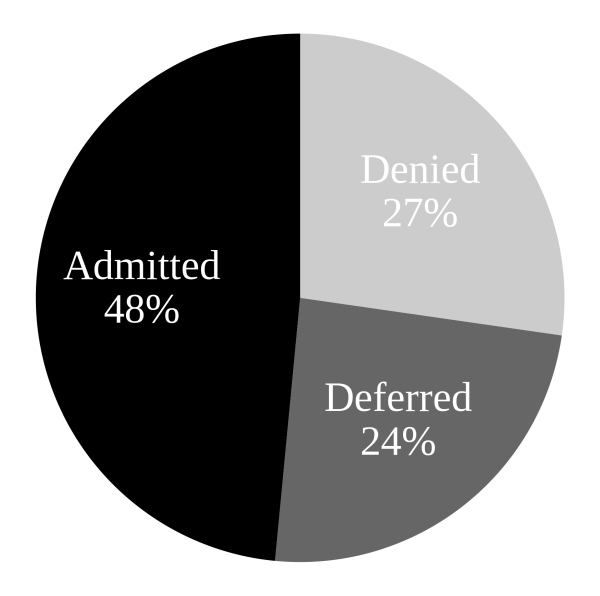
The Class of 2026 received early college admissions decisions in December, with most students applying to schools through Early Decision (ED) and Single-Choice Early Action (SCEA), according to school administrators. Of those applicants, 48% were admitted — a rate nearly identical to those of the Class of 2025 and among the strongest early admissions outcomes of the past five years — while 27% were rejected and 24% were deferred.
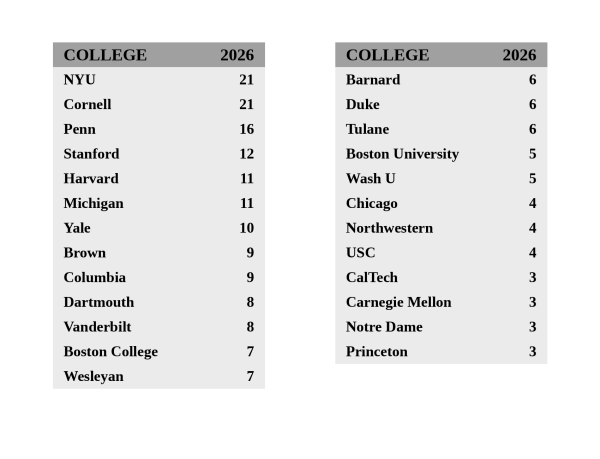
These outcomes followed months of preparation that began well before December, as students refined their lists and determined their early application targets. Among the 302 students in the Class of 2026, 242 ED and SCEA applications were submitted, according to Upper School Dean Sharon Cuseo. The 25 colleges that received the most early applications included the eight Ivy League schools, Stanford University, Barnard College, Boston College, Boston University, Carnegie Mellon University, Duke University, University of Michigan, Northwestern University, New York University, Smith College, Tufts University, Tulane University, University of Chicago, University of Southern California, Vanderbilt University, California Institute of Technology, Washington University in St. Louis and Wesleyan University.
Cuseo said this year’s senior class performed strongly in the early admissions round despite the trend of many students applying to highly selective schools.
“The class did extremely well in the early process this year,” Cuseo said. “We were nervous about the lack of variety and the appearance of being overly ambitious, but the results are comparable to last year in terms of acceptances, which is a very good thing. It aligns with the most successful results in the past five years.”
In terms of strategy, Cuseo said the class followed an ambitious but relatively conventional blueprint, with early applications concentrated among familiar schools.
“I’m not sure I would characterize the Class of 2026’s approach as strategic,” Cuseo said. “It definitely seems to have been ambitious and fairly traditional, not venturing too far from the ‘usual suspects’ of selective college admissions. A higher percentage of the Class of 2026 applied to Ivy League schools plus Stanford than in previous years. Nearly one-third of the class applied early to those nine schools.”
Administrators noted that this year’s results stood out against the context of longer-term trends the school has tracked. President Rick Commons said he is surprised but impressed that the Class of 2026 defied the school’s usual “pendular swing,” referring to a pattern in which odd- and even-numbered graduation years tend to alternate between applying more heavily to highly competitive schools and opting for relatively less selective choices.
“I was surprised by the results because we’ve heard of the pendulum, and this year it swung in our favor a little bit more,” Commons said. “The Class of 2026 defied the usual pendular swing. The magic number for the deans is when about 50% of the class is getting good results early. Overall, it was a pleasant surprise.”
Head of Upper School Beth Slattery said she is thrilled by the class’s impressive performance, particularly amid earlier concerns that student success might have been limited due to a high concentration of applications to a few selective schools.
“My impression is that it was a pretty successful year,” Slattery said. “[The administration and dean team] had talked in the past about concerns because there was so much clustering at a certain set of schools, but it appears that we were equally successful at those most selective schools as we have been in the past. It also appears that compared to last year, we were more successful at the next tier of schools. There were a lot of schools that took a lot of our kids, and that helped to bolster things. Similar to other years, a very large percentage of this class is done, which is great.
Dean Kim ’26 said he attributed the class’s favorable early outcomes to hard work and a willingness to take risks in the application process.
“A lot of people in our grade had the confidence to really shoot their shot this year,” Kim said. “Looking at last year’s results gave people reassurance, and our class worked really hard overall. There were definitely some surprises and disappointments, but everyone applied to different types of schools and brought something unique, which is why so many people ended up with good outcomes.”
Beyond the statistics, several students emphasized the mentors and support systems that helped them navigate the application process. Aidan Usher ’26 said his dean provided him and his family with critical, holistic support.
“My dean, [Chris Jones], was an amazing mentor,” Usher said. “My parents were always stressing about the college admissions process, and he would always try to help them in any way possible. He was also a source of mental support and kept me stable. He always had my back the whole time.”
Daniel Baek ’26 said his parents’ steady guidance also played a key role in his success.
“My parents helped me a lot in researching and figuring out what qualities I looked for in a school,” Baek said. “They helped me when I procrastinated a bit with my essays and provided emotional support throughout the entire process. I owe a big majority of who I am because of their effort and dedication, so it only made sense that they’d be the ones guiding me through one of the biggest decisions of my life so far. They know me better than anyone else, so their involvement in the admissions process was really an extension of the support they’ve always given me.”
As underclassmen begin to think about their own early applications, seniors urged the importance of thoughtful preparation focused on individual school fit. Will Rosen ’26 said he encourages future students to carefully research colleges to ensure their early choice is truly their top pick and a school they would attend without hesitation.
“Applying early is a great option for those who have a firm idea of a first-choice school,” Rosen said. “In addition to extensively researching, make sure to apply ED somewhere that you would have absolutely no regrets.”
Administrators echoed the seniors’ advice, reminding students to maintain breadth and fit whilebuilding a list. Cuseo said she encourages students to keep an open mind during the college search process.
“Visiting as wide a variety of schools as possible is always good advice,” Cuseo said. “You don’t know what’s possible or what might click for youif you haven’t seen it. You will always be happier if you can find some realistic options that you might consider in the early process. Even if you don’t apply early to one of these, you can feel better about taking a chance early if you have options you know you will like later on.”