





Teenage girls from around the country flock to Oceanside, California for the start of a weekend-long soccer tournament. It is the day after Thanksgiving, and by 2:00 p.m., the 2025 San Diego Surf College Cup Showcase is in full swing. When Shaili Betesh ’27 lunges to kick the ball from a defender on her tail, her right knee gives in and collapses with a sickening pop. Betesh said she tore her anterior cruciate ligament (ACL) when she fell.
“I immediately knew what I was going through,” Betesh said. “The way my knee popped, felt loose and turned inward was a textbook example of an ACL injury.”
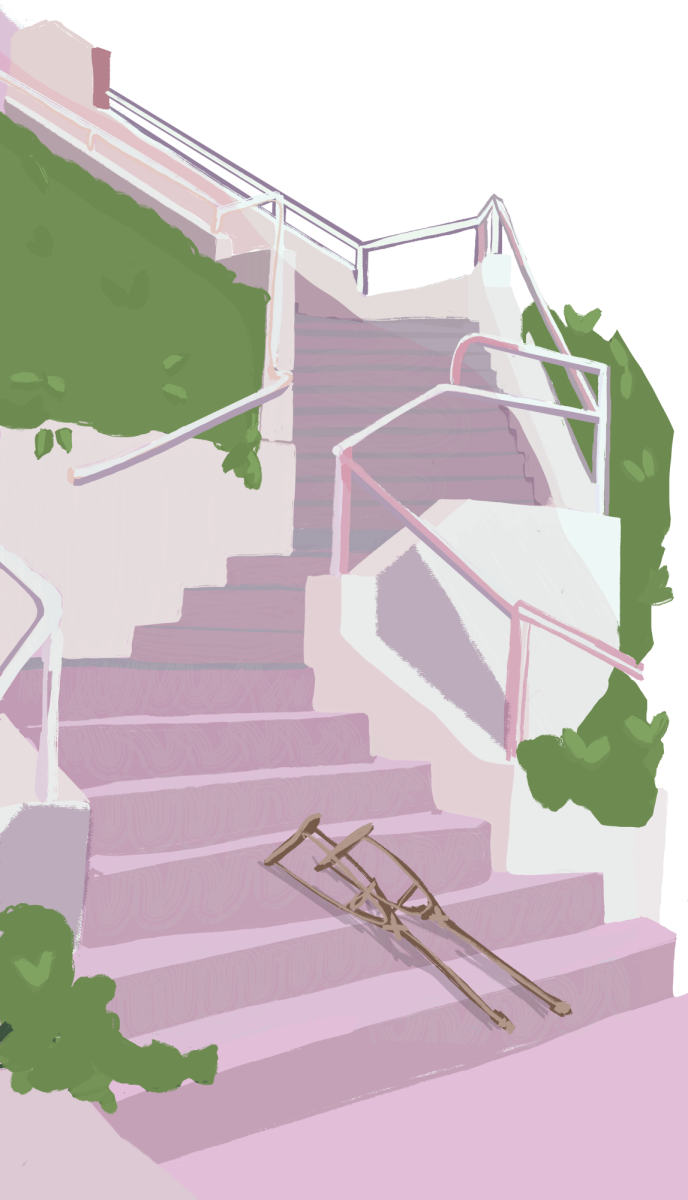
After tearing her ACL and lateral meniscus, Betesh underwent an operation to reconstruct her knee. Now, she uses crutches to navigate a school campus where 83% of students report climbing seven or more flights of stairs per day, with 21% of students climbing over 12 flights per day, according to a Chronicle poll. Betesh said she strives to keep a positive mindset about her injury despite the difficult recovery journey ahead.
“After such an intense knee surgery, I try to stay optimistic by reminding myself that I’ve been through the hardest part of this process,” Betesh said. “It’s almost impossible to get around school without encountering at least a few flights of stairs. No matter what I tell myself, the path ahead of me is still extremely challenging.”
The map of the upper school campus shows an elevator in Munger Science Center and another in Chalmers Hall, according to hw.com. The map recommends contacting security for assistance, acknowledging that the school is built on a hillside and navigating the campus often requires several flights of stairs.
Sahana Narang ’28, who fractured her foot during rehearsal for the upcoming school musical, said managing an injury while also completing a standard school day is overwhelming.
“Even with everyone here to help, I dread coming to school because all I can think about is having to walk uphill while handling crutches,” Narang said. “A backpack full of books, binders and notebooks only makes it more of a struggle.”
Kit* ’27, who has a permanent condition that limits their mobility, said the school supports its students who need help navigating campus.
“There’s not much that anyone can do about the campus being on a hill,” Kit said. “There are days when the geography exacerbates my condition, but the school has been helpful in trying to minimize that.”
The school employs a range of strategies to minimize the physical challenges students face. Community Health Officer Milo Sini said the school will do whatever is necessary to ensure a student is able to participate on campus, including relocating a class if someone is unable to climb the stairs.
“We use every possible way to accommodate our students,” Sini said. “We may email their teachers, ask another student to help carry their books, set up a system so the student can Uber to school each day, or, in one case, move a class to help a student access the room more easily. Nothing is off the table.”
Parker Rockwell ’27, who broke his ankle during spring break of his sophomore year, was on crutches until summer vacation. Rockwell said he witnessed the school’s commitment to accommodating his injury when it shouldered some of the cost of taking an Uber to school each day.
“I didn’t know how I would get to school because I hurt my right foot and couldn’t drive,” Rockwell said. “My parents were at work, and the bus wasn’t an option because my ankle was too fragile to go up and down the steps of the bus. My dean suggested Uber, and the school ended up paying most of the cost to travel every day. There was so much to figure out, but the school did a lot to help.”
The security team often facilitates an injured student’s movement on campus by assigning accessible parking spots, allowing parents to drive their children directly to class and transporting the student in the security cart. Head of Upper School Security Earl Saunders said the team will do as much as possible to help an injured student travel with ease.
“If there are no elevators or if a student is going from one side of the campus to another, we’ll come over, pick them up and drive them from point A to point B,” Saunders said. “We’ll take as many trips as we have to make to help the student get around with less of a struggle.”
Rockwell said he enjoyed getting to know Saunders last year.
“Earl was nice company,” Rockwell said. “I still talk to him about football in the mornings, and I’ve always thought it was cool that he has a motorcycle.”
Saunders said he loves to learn more about the students when they travel across campus together.
“We talk about their day, the sports they’re involved in or how they got hurt,” Saunders said. “I ask about their future, what school they want to go to, what they want to study and even their long term goals. Maybe they want to be a doctor or a lawyer or a similar kind of profession. We become friends. I have a lot of grandkids, and I look at them as another kid in my family.”
Betesh said she has valued friendship while managing her injury, relying on the people she loves to keep her situation in perspective.
“Immediately after my surgery, all of my friends reached out and some of them came over to my house for a couple of hours,” Betesh said. “It made me so happy to see them, and it took away the pain. Even though I was sitting in bed injured, they helped me focus on the positive parts of the moment.”
Kit said their friendships are integral to having a balanced high school experience that makes sense for them.
“I have a lot of good friends who make an effort to understand my situation,” Kit said. “After hanging out once, I feel exhausted, done for the week. It’s really nice that my friends are understanding of what I can and can’t do. Even though I definitely don’t have the usual high school experience, I’m still having my own unique one.”
Many students also notice profound growth within themselves as they overcome specific obstacles. Kit said their experience with chronic illness has made them more confident.
“I might have a good day when I am running around, and the next day I won’t be able to walk at all,” Kit said. “Sometimes, I get weird looks from people who say, ‘Oh, but you were fine yesterday.’ It’s hard for people to understand exactly what it’s like to be in my position. It took me a year and a half to even get a diagnosis, but this entire situation has taught me how strong I really am.”
Betesh said her experience has uncovered a determination that she had never before seen in herself.
“I am much stronger than I ever thought I was,” Betesh said. “This journey has been challenging and I’ve had to fight through a lot of pain, but I have done things that I never believed I could do.”
*Name has been changed.
