








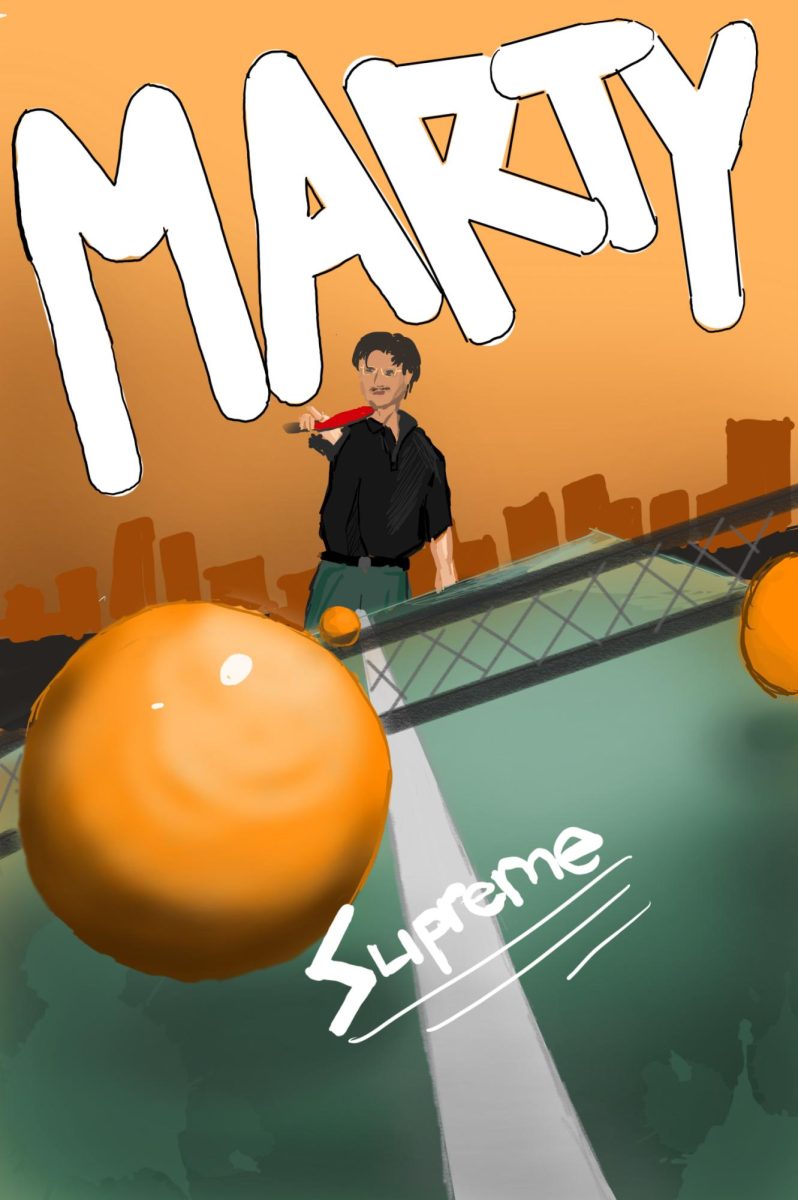
Director Josh Safdie is back on the big screen with the release of his newest highly anticipated film, “Marty Supreme” on Dec. 25 2025. The film succeeds as an energetic, beautifully filmed drama grappling with the dangers of strong ambition. The main protagonist comes across as highly unlikeable, and yet it feels appropriate because the film functions as a character study rather than the classic heroic sports drama. However, the movie does feel repetitive at times, and the lack of character development leaves the ending to feel unsatisfactory.
Set primarily in post World War II New York, “Marty Supreme” follows Marty Mauser [Timothée Chalamet], a gifted but unstable ping-pong hustler determined to dominate the world of table tennis. Rather than framing his rise as inspirational, the film portrays ambition as something corrosive. Mauser’s talent opens doors, but his arrogance and impulsiveness repeatedly sabotage his progress. Safdie avoids the familiar underdog hero arc, instead presenting success as something that can burn bright but short. The film is based loosely on the real-life ping pong champion Marty Reisman, yet it diverges from the traditional biopic for more creative liberty. Resiman’s family was not consulted for the creation of the script or production of the film, taking pressure off the creative team to portray Mauser in a positive light. This portrayal distinguishes the film from more conventional sports dramas, which often soften their protagonists for a more heroic portrayal.
Chalamet delivers a committed performance that leans into Mauser’s contradictions. His portrayal of Mauser is charismatic and sharp, yet frequently difficult to sympathize with. He demands admiration but acts with little empathy towards others, framing every relationship as either transactional or competitive.
The film’s visual style reflects Mauser’s internal restlessness. Tournament scenes are shot with close framing and rapid movement, emphasizing tension over spectacle. Between matches, Safdie lingers on back rooms, bars and improvised games, grounding the story in environments shaped by hustle rather than institutional success.
However, the film’s pacing may challenge some viewers as it moves quickly through key moments in Mauser’s career, often prioritizing personal moments over the sport itself. Supporting characters drift in and out of the narrative with limited development, which can make Mauser’s relationships feel underdeveloped. While this approach reinforces the film’s focus on Mauser’s isolation, it creates a lack of narrative cohesion throughout the story. Additionally, by the end of the film, Mauser exhibits seemingly very little character development. His poor treatment of others and self-obsessed nature go unpunished throughout the movie, which creates an unsatisfactory ending. While the movie does act as a cautionary tale with an intentionally obnoxious protagonist, at times, Mauser is too unlikable to tolerate, which makes the 2-hour and 29-minute runtime drag on.
The movie initially caught the public eye through a bold marketing campaign led primarily by Chalamet himself, instantly recognizable for its complete neon orange branding. Marketing involved physical stunts, such as an orange blimp that flew over Los Angeles and an ad featuring Chalamet on top of the Las Vegas Sphere, according to Business Insider. Additionally, Chalamet hosted multiple exclusive pop-up stores in Los Angeles, London and New York, which sold limited “Marty Supreme” branded jackets that several celebrities purchased and wore.
The film did quite well amongst critics and was awarded Best Picture at the British Academy of Film and Television Arts (BAFTA) and Critics’ Choice Awards. Lead actor Timothée Chalamet was also nominated for an Oscar for Best Actor, along with Safdie for Best Director.