








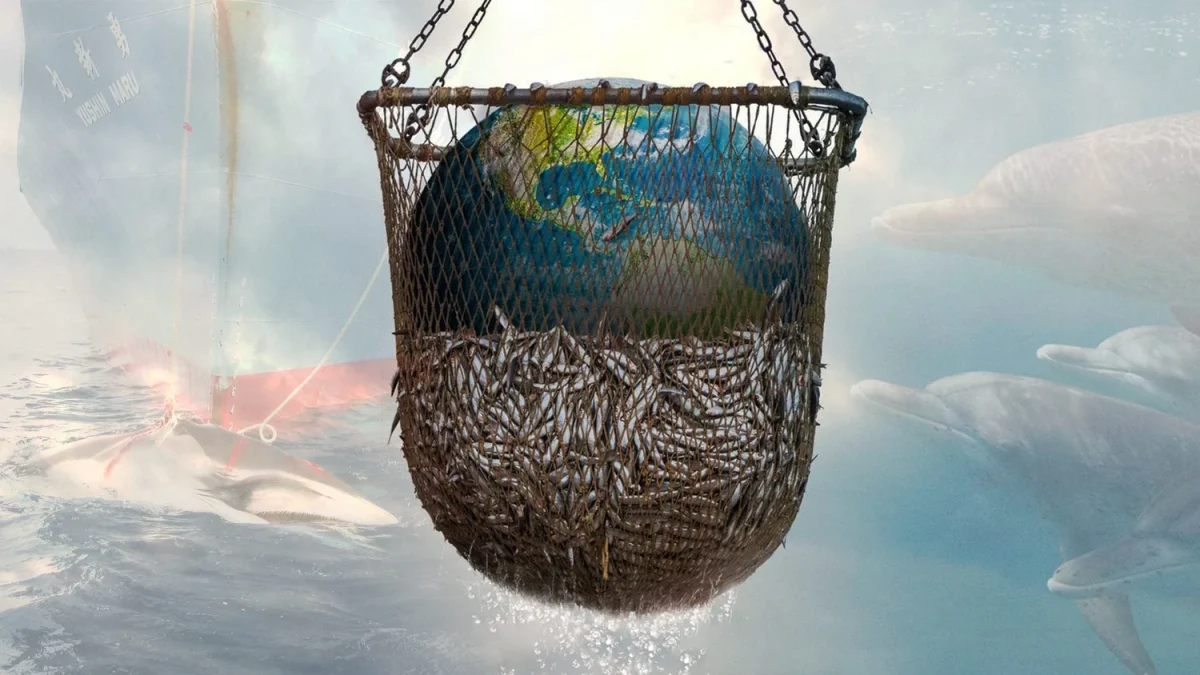
“Seaspiracy” explores the environmental damage caused by the global fishing industry and challenges the idea that seafood is a sustainable or ethical food choice. The documentary explains how industrial fishing has led to severe overfishing, habitat destruction, and biodiversity loss, noting that around 90% of the world’s large fish populations have already been depleted. It highlights destructive practices such as trawling, which scrapes the ocean floor and destroys ecosystems, and bycatch, which results in millions of dolphins, whales, turtles, and sharks being unintentionally killed each year.
The film also exposes how fishing contributes heavily to ocean pollution, revealing that discarded fishing nets and gear make up nearly half of the Great Pacific Garbage Patch. However, this fact is often times overlooked because the people never talk about this alarming fact and focus on plastic instead because big companies don’t want to give up fishing and its economic profits.
These issues connect directly to agriculture and water quality because fishing is a form of food production that, like industrial farming, prioritizes profit over sustainability. Overfishing disrupts food webs, reduces the ocean’s ability to absorb carbon dioxide and produce oxygen, and contributes to bioaccumulation and biomagnification of toxins such as mercury within marine food chains, ultimately harming human health.
Personally, the documentary made me feel deeply upset, frustrated, and saddened by the greed and selfishness driving the overexploitation of ocean resources. Watching fish, sharks, whales, and dolphins being mass-killed or captured was heartbreaking, and it completely changed how I view seafood consumption.
I was especially surprised because I had always believed that eating seafood was a more environmentally friendly alternative to beef or pork, but “Seaspiracy” showed that seafood production can be just as damaging, if not more, due to overfishing, habitat destruction, and little to no regulation.
The film challenged my thinking about sustainability and connected sustainability concepts such as resource depletion, biomagnification, and the environmental impacts of our food choices. It emphasized that the most effective solution is reduction – consuming less, wasting less, and shrinking our ecological footprint. After watching the documentary, I felt inspired to limit my seafood intake and spread awareness (I even talked with my family for nearly 40 minutes afterward because I felt so strongly about what I learned).
Overall, “Seaspiracy” reinforced the idea that if humans continue to live in excess without considering long-term consequences, both the environment and the species in it – including humans themselves – will suffer. Meaningful change is still possible, however, if we reduce consumption, regulate harmful industries, and stop treating the ocean as an unlimited resource.
