







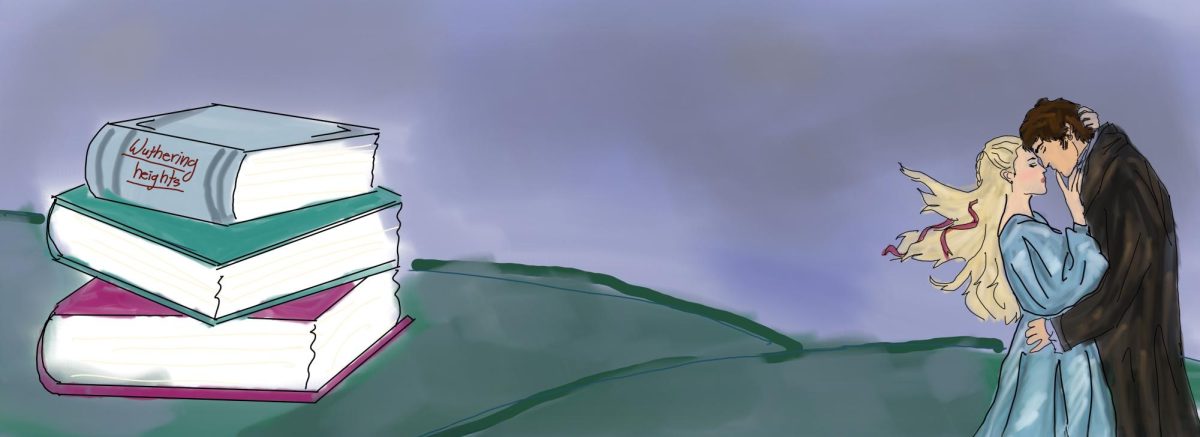
Abby Landres ’26 stands up and walks away from the movie theatre, feeling unsettled as the credits start to roll. She just finished watching the new “Wuthering Heights” live action adaptation of Emily Brontë’s classic novel. Leaving the theatre unsatisfied, Landres reflects on the romantic relationship between the main leads. Landres said the film left an unnerving impression on her through its glorification of harmful relationships.
“My main issue was that it romanticized abuse, both physical and emotional,” she said. “The movie was very vulgar, but between the end of the film, constant reminders of the characters love and the Valentine’s promotions around the movie, it felt like it was promoting horrible relationships.”
There was another choice in this adaptation that frustrated her, which was the casting of Jacob Elordi as Heathcliff. In Brontë’s original novel, Heathcliff’s racial ambiguity and outsider status are central to his characterization. With Elordi playing Heathcliff, this characterization is glossed over in the film adaptation, according to the New York Times. Landres said the casting erased an important part of Heathcliff’s identity.
“It was made obvious in the original novel that Heathcliff wasn’t white,” Landres said, “There is just no reason to be erasing someone’s identity in the media for the sake of popularity or a certain aesthetic.”
However, not all viewers shared this sentiment. Upper School Video Art teacher Mx. Limerick said she enjoyed Emerald Fennell’s adaptation of “Wuthering Heights” despite not being familiar with the original novel.
“I absolutely loved Emerald Fennell’s Wuthering Heights adaptation,” Limerick said. “I haven’t read the book, so I didn’t have any connection to the original source material. I found myself having a blast in the theatre, enjoying the sweeping, over-the-top romance and melodrama paired with the beautiful and grotesque stylistic details. I didn’t even realize it was a tragedy, so the ending caught me completely off guard, and I was sobbing in the theater.”
Limerick said although she enjoyed the film, she later recognized flaws in its casting choices.
“I later learned that Heathcliff is written as a person of color, which made casting Jacob Elordi feel like a missed opportunity to give the role to a Black or brown actor,” Limerick said. “Remakes can sometimes serve as a second chance to cast actors who are more culturally aligned with the character, like when Rachel Zegler, who is of Colombian descent, was cast as Maria in the West Side Story remake. So, I do recognize the overlooked opportunity.”
In recent years, live action remakes have been produced at a rapid pace but with criticism. Both “Pinocchio” (2022) and “Snow White” (2025) faced box office failures, with the latter causing Disney to lose an estimated $170 million, according to Forbes.
A 2019 study analyzing Metacritic scores found that in 91% of cases audiences responded more negatively to live action remakes than to the original films, according to the Washington Post. Moreover, Rotten Tomatoes’ Top Critics ratings for Disney animated movies averaged 37 points higher than the average rating for the live action adaptations, according online entertainment publication ScreenRant.
Jackson Sunwoo ’27 said that the appeal of live-action remakes lies in their reliance on nostalgia.
“People like revisiting movies they grew up with and seeing them in a new format,” Sunwoo said. “It’s more about reliving something familiar and trying to live in the past. There’s also that impressive factor of seeing something animated turned into live action.”
Sunwoo said he dislikes the remakes because they are driven by financial gain and just rehash the original story without nuance, which harms innovation in the movie industry.
“A lot of the time, the remakes feel like studios are financially motivated and just trying to grab a big market instead of actually making something meaningful,” Sunwoo said. “Studios utilize a name that’s already popular and use it to try to sell something seemingly different, but [the adaptation] is not actually anything new or special. Because they’re relying on that nostalgia factor, they don’t have to be as innovative. That ends up making the industry less creative overall, since we’re just redoing ideas that were already innovative the first time.”
Genevieve Watson ’27 said recent live action adaptations such as “Snow White” have disappointed her with their vapidity and lack of spirit.
“‘Snow White’ was Disney’s first animated feature and it had so much spirit,” Watson said. “On the other hand, the remake felt dull and flat. The acting wasn’t great, the songs didn’t have the same energy and it didn’t feel like anyone was passionate about making it. Unfortunately, the film appeared to be a watered-down version of something that, originally, was really special and had a lot of heart.”
Watson said she would prefer it if remakes deviated from the original to offer a unique and distinct interpretation.
“I prefer when remakes take a different approach,” she said. “If they deviate from the source material in a thoughtful way, it can offer interesting new insights. I would much rather see that than a direct recreation every single time. The original usually does what it does really well, so if you want to make a remake be interesting or meaningful, you have to offer a different insight to make it worth watching.”
Haley Romano ’27 said Disney live action adaptations have disappointed her.
“Disney has been particularly criticized the most for their uninspired adaptations of their beloved animated film because it just feels like they are recycling their intellectual property,” Romano said. “I have seen that all over the internet in forums, movie blogs and social media, there is a broad consensus that Disney should move beyond their bland live action remakes and towards original animated stories.”
Sunwoo said what makes the remakes feel unsettling is the uncanny computer-generated imagery (CGI), along with the fact that their primary selling point appears to be nothing more than their live action format.
“In the live action ‘Lion King,’ the characters were not very expressive,” Sunwoo said. “Animation allows for exaggerated facial expressions and emotion, but when you try to make hyperrealistic animals act like humans, it can feel strange or stoic. It seemed like they needed better technology to accomplish what they were aiming for. Additionally, it felt like the main selling point was ‘look, it’s a real lion singing’ or ‘we rendered this in 3D.’ A remake shouldn’t be marketed just because it’s live action.”
Romano said, in the future, Hollywood should place more attention on the plot of movies.
“In order for Hollywood to lure more people into the theaters, they really should focus more on the stories,” Romano said. “Recently, we’ve been seeing an increase in tools such as artificial intelligence (AI) and virtual production, which creates extraordinary visuals. However, there has been less of an emphasis on plots. This makes movies feel flat because even though people love stunning visuals, having a good story is equally as important. In the future, I hope Hollywood will be able to create more unique stories, take risks on stories that are unconventional, while also including more voices and varying perspectives.”