







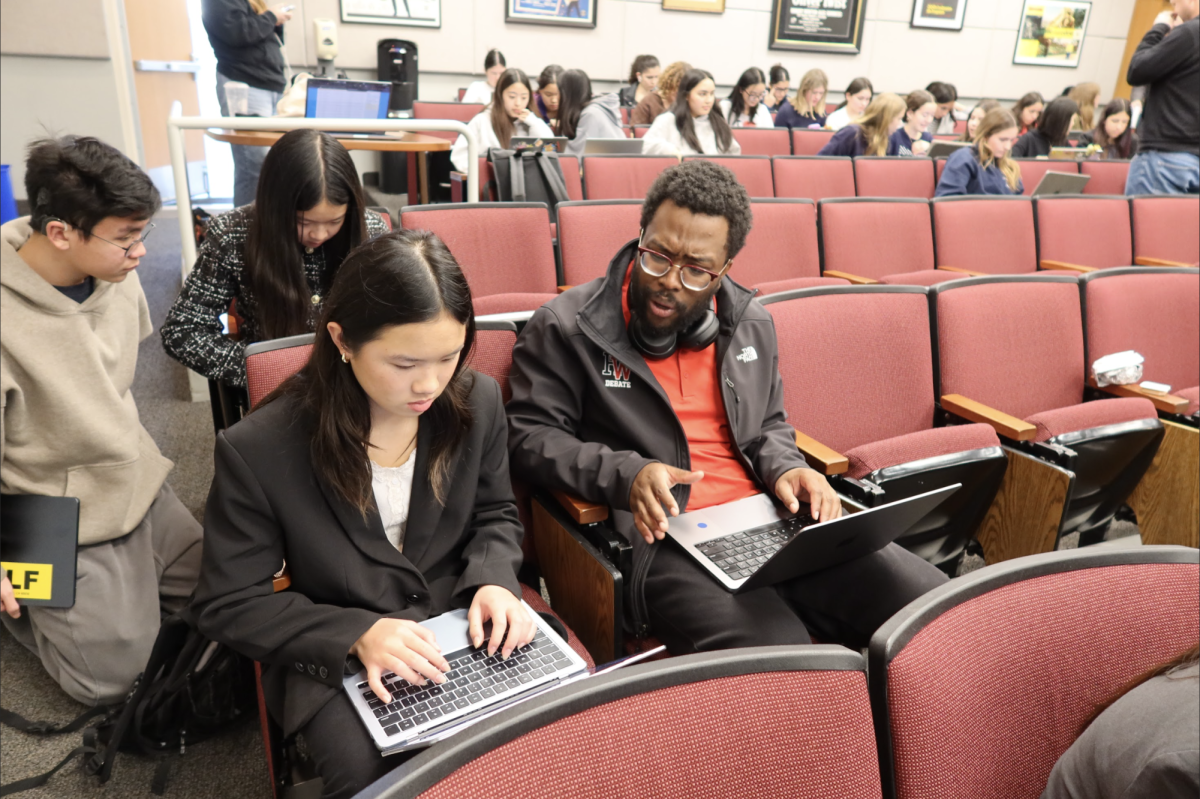
The school hosted its 12th annual debate tournament, Harvard-Westlake Debates, from Jan. 17-19. Approximately 300 competitors and judges traveled to the Upper School from across the country to participate.
The debate tournament featured three events: varsity Lincoln-Douglas, novice Lincoln-Douglas and World Schools. Lincoln-Douglas is a two-person debate event focused on ethical and philosophical issues, while World Schools consists of a mix of prepared and impromptu topics debated between teams of three to five people.
The Middle School debate team competed in the novice Lincoln-Douglas event, but the Upper School Debate team did not enter the varsity Lincoln-Douglas category due to concerns regarding fairness in judging. Instead, members of the Upper School Debate team served as judges throughout the tournaments.
Head of the debate program Scott Phillip said the tournament offered a unique opportunity to debate with top competitors nationwide and participate in the World Schools division.
“Students got a chance to compete against the best debaters from across the country, many of whom they don’t normally see or debate against at Southern California tournaments,” Phillip said. “We also had an in-person World Schools division, which is a rarity, since most of those tournaments are held online.”
Jacob Waxman ’27, a member of the Upper School Debate team and a judge for the novice Lincoln-Douglas event, said his role as a judge included taking organized notes and providing feedback for the participants.
“[Being a judge] involves being both an impartial adjudicator whilst also being a good educator and ensuring the safety of a space,” Waxman said. “On a more specific level, I have to take notes, called a flow, throughout the round of all the arguments made by both sides. After the conclusion of the round, I then take time to think about, write and disclose my decision and my explanation for it. Then I give feedback and answer questions from the competitors in the round.”
Sage Bonotto ’27, also a novice Lincoln-Douglas judge, said he evaluated debates based on the argument structure rather than factual accuracy.
“My role as a judge means that I have to evaluate what is said and only what is said throughout the course of the debate round, regardless of how truthful the argument is,” Bonotto said. “At the end of the debate, I make my decision based on whichever side provided both offensive reasons as to why they should win as well as defensive reasons as to why their opponent should lose.”
Julia Thomas ’27, who judged in the novice Lincoln-Douglas division, said the students’ enthusiasm in debate and efforts to create original perspectives stood out the most.
“Students’ performances demonstrated how interested they were in debate,” Thomas said. “I could tell people were trying to think creatively and develop new ideas to the topic.”
Bonotto said his experience as a debater helped him remain objective when judging.
“Since I’ve started debating, it’s become easier for me to stay objective when judging arguments I might personally agree or disagree with,” Bonotto said. “Experience plays a big factor in overcoming that obstacle that might arise when judging. Judging debates has become helpful in understanding how I, as a debater, can be more technically sound when I’m debating, since I now know what judges want out of their competitors.”