






The site of the 2023 Nova Music Festival in Re’im Forest, Israel, is eerily quiet. A small breeze rustles along the grass, sweeping past the sticks planted in the ground, their posts adorned with rocks and sunflowers. Taped to these sticks are pictures of loved ones that were massacred by Hamas on Oct. 7, 2023. Upper School History and Interdisciplinary Studies Teacher Dror Yaron stands in the dirt, his gaze fixed on the photos as the weight of what was lost settles around him.
Oct. 7, which was the deadliest day in history for Jews since the Holocaust, had roughly 1,200 casualties, mostly civilians, and 250 hostages taken to Gaza by Hamas, according to The New York Times.
Yaron, who was born and raised in Israel, said the first time he visited after Oct. 7, he immediately went to the grounds of the Nova Music Festival to pay his respects to those killed.
“The first thing I did was go to visit the sites of the massacre and pay tribute, with my presence, with my thoughts, with my prayers, with my reflections, with my tears, with my deepening contemplations and with my quintessential identity as an Israeli,” Yaron said.
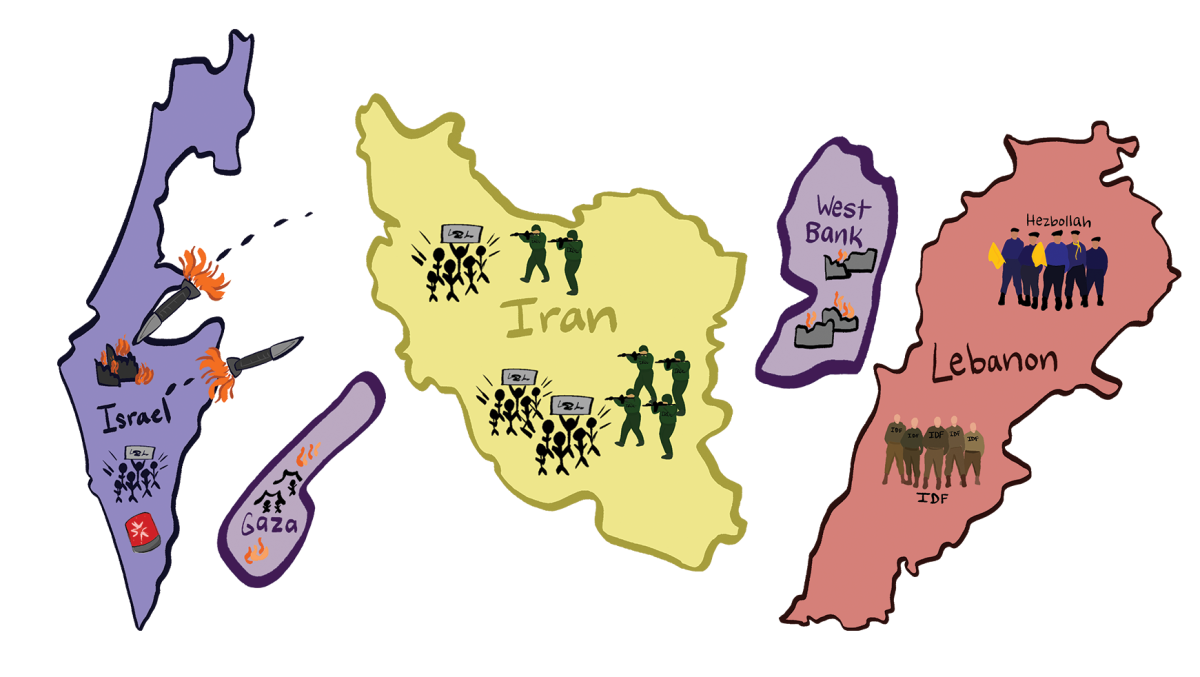
Just 5 kilometers east of the music festival grounds lies the Gaza Strip. The ensuing Israel-Hamas war has left 72,000 Gazans dead, according to the Gaza Health Ministry. 1,079 Palestinians have died in the West Bank. 90% of Gaza’s population (~1.5 million) has been displaced, and at least 1.6 million Gazans are facing high levels of acute food insecurity, according to a December 2025 United Nations Report.
Jordanian-Palestinian Khadija Alsharif ’27, who has family in the West Bank and Jordan, said the constant conflict in the Levant region has consumed much of her life.
“I go home and it’s my whole life, from the food we eat to the language we speak, to always watching the news,” Alsharif said. “We’re always waiting for the next thing to happen. So much of my life is consumed by being Palestinian and Jordanian, and Arab in general, because the region in the past five years has gone through so much.”
Yaron said despite his anxiety for the safety of his family and friends in Israel, he has learned to accept the daily danger as an immutable part of their lives.
“While it’s stressful, it’s, and I say this with a heavy heart, predictable that there’s going to be dramatic and stressful disruption day to day,” Yaron said. “It’s an acceptance that the people who I love, and I’m very much connected from birth to, are under a continuous sense of duress.”
Alsharif said she has struggled with feeling alone in her Arab identity and deciding what parts of it to share with others.
“It’s been really hard for me because survivor’s guilt is such a thing, and I want to be super outspoken about being Arab in general, but you never know what people are going to say to you,” Alsharif said. “I’m overly aware of my environment, especially at Harvard-Westlake, leading me to be very conscientious about what I say and around whom. I find myself constantly having to self-monitor, because there are people who categorically oppose parts of my identity.”
Israeli-Iranian Olivia Davidov ’28 said the conflict has caused her to become more aware of being Israeli as she has grown to fear other people’s perceptions of her identity.
“I do feel a little bit conscious about saying that I [am Israeli] in front of people because now, post Oct. 7, it’s become such a polarizing topic,” Davidov said. “So, I am kind of nervous about how people will think about me after I share that part of my identity.”
The regional tensions have escalated beyond Israel and its immediate neighbors, drawing in additional actors. On Feb. 28, the United States and Israel jointly attacked Iran. They aimed to weaken its nuclear facilities, military infrastructure and leadership, according to the American Jewish Committee (AJC). Over the course of the campaign thus far, Israel has conducted more than 10,800 strikes, and the United States has carried out approximately 13,000. The war follows massive demonstrations in Iran protesting the Iranian Regime that began on Dec. 28. The government crackdown in response led to over 30,000 deaths, according to Time.
Since the war started on Feb. 28, nearly 2,000 civilians, including 250 children have been killed, according to the Center for American Progress. Additionally, 22 schools and 17 health care facilities have been damaged, according to The New York Times. Davidov said it has been difficult to witness the tragedy in Iran from afar, especially considering the ongoing uncertainty and scale of the loss.
“Seeing all the devastation in Iran has been incredibly difficult and heartbreaking,” Davidov said. “There have obviously been mass casualties over the past months, escalating from the tens of thousands killed in just two days in early January by the Iranian Revolutionary Guard Corps (IRGC). It is especially hard watching from afar with so much uncertainty about the outcome of all of this because everything feels so unpredictable. My biggest concern is for the Iranian people and their well-being.”
Iranian and Middle Eastern Student Association (MESA) leader Dhara Jobrani ’26 said his concerns about the region are tied more to his aspirations to work in the region than to his familial or historical connections.
“[It changes] how I think of my future,” Jobrani said. “My dream has always been to do business in the Middle East, and to see this kind of conflict happening, it makes you kind of second guess yourself, to say, ‘Do I really want to invest my time and effort into a region that’s always going to have instability?’ It was really sad for me to see this kind of conflict happen.”
After the Islamic Republic came to power in Iran following the 1979 revolution, the oppressive regime immediately began persecuting its non-Muslim minorities. The number of Jews in Iran decreased from 100,000 to 9,000 today, according to Jewish News Syndicate (JNS).
Davidov said the anti-Semitic attitudes pervading in Iran make it unlikely that her family will ever return to the country, a sentiment that contrasts the hope her Israeli family feels about the war and for the region.
“Even before the revolution, antisemitism was so prevalent that [my Iranian family] feels like, even if there is regime change or significant alteration with the leadership in Iran, there wouldn’t really be opportunity for us to return or for them to go back to the country that they once loved so much,” Davidov said. “My Israeli side of the family does seem to have more hope about the situation.”
This uncertainty is felt by those with family throughout the entire region. Lebanese student Lulu Aridi ’27, whose extended family mostly lives in Lebanon, said she is constantly on high alert for developments there as she is unsure of what her relatives are facing.
“I don’t know what my family is going through,” Aridi said. “I don’t know if they’re even going to survive the next few years, what’s going to happen to them and their kids. I have a very large family, so pretty much everyone is impacted in some way. I’m not hearing from certain people, some are sending pretty bad updates. It definitely does make me very, very conscious of this whole thing.”
Israel and the Iran-backed Lebanese Hezbollah have been involved in armed conflict since Hezbollah attacked Israel following the Oct. 7 attacks. 2,196 Lebanese have died and more than one million have been displaced due to Israeli attacks, according to AlJazeera.
Aridi said worsening economic conditions and ongoing attacks have deteriorated the quality of life for her family in Lebanon.
“Lebanon is just very, very poor overall,” Aridi said. “The quality of life has honestly been going downhill for a long time. Especially now, with the increased attacks and the whole Israel situation, it’s definitely gone from a lower quality of life to just living in peril. They see drones and planes every day. An apartment 10 minutes from one of ours got bombed. It’s definitely happening right in front of us. People are seeing the explosions from their windows.”
While members of the school community navigate the challenges and tragedy that come with conflict in their home countries, many others remain largely unaware of the depth and complexity of these crises. Aridi said many Americans tend to overlook Lebanon because of its perceived unimportance, but that people should still be well-informed about the situation there.
“Americans have kind of turned a blind eye to Lebanon,” Aridi said. “At the end of the day, it’s a very small country, [and it] doesn’t really affect the U.S. whatsoever, like Iran or other places in the Middle East might. But I think people should still be so aware and educated in what’s going on.”
Yaron said he understands why many may not understand the nuances of Middle Eastern politics, but that it’s important for people to educate themselves and approach the issues with openness and understanding.
“I don’t blame the students here that don’t understand the intricacies, the complex dynamics, the contradictory patterns of Middle Eastern political life,” Yaron said. “I would always suggest that those who have such staunch certitude and state things with emphatic resolve, regardless of their sides, need to take a step back and know that this conflict for the people who are impacted by it is so much more grave, and so much more palpable. It requires us to learn, grow, accumulate knowledge and synthesize contentions [and] opinions, but with an evolving, open mindedness.”
Alsharif represents those who are deeply connected to conflicts across the Middle East and therefore hold nuanced and complex perspectives. Alsharif said hope for Palestinian liberation is an important part of her identity, yet the prospect currently feels distant and unlikely.
“So much of our faith and how we lead ourselves is to always have hope, but we also understand the reality of the situation,” Alsharif said. “So much harm has been done, it’s like, ‘What good can come out of it now?’ But, we’re always hopeful that we can be liberated as a people, [gain access] to our land and to be able to live in dignity.”
This combination of hope and hopelessness is only partly reflected in Israel. Israel was ranked the 8th happiest country in 2025, according to the World Population Review. More than 78,000 sirens warning of missile, rocket and drone attacks have gone off in Israel since Feb. 28, according to The Times of Israel. Yaron said the attitude of happiness in the midst of crisis is an integral part of the nationalist identity in Israel.
“The great inspiration that [Israel] offers is the vitality to live and live well, and be happy because happiness for the Israeli is a moral imperative,” Yaron said. “It seems like an ironic twist that, despite all this exhaustion and duress and stress and existential angst, Israel still has the capacity within its sense of peoplehood, as well as a vibrant and vital individuality, to be a country that still lives life to its fullest under the circumstances.”
