







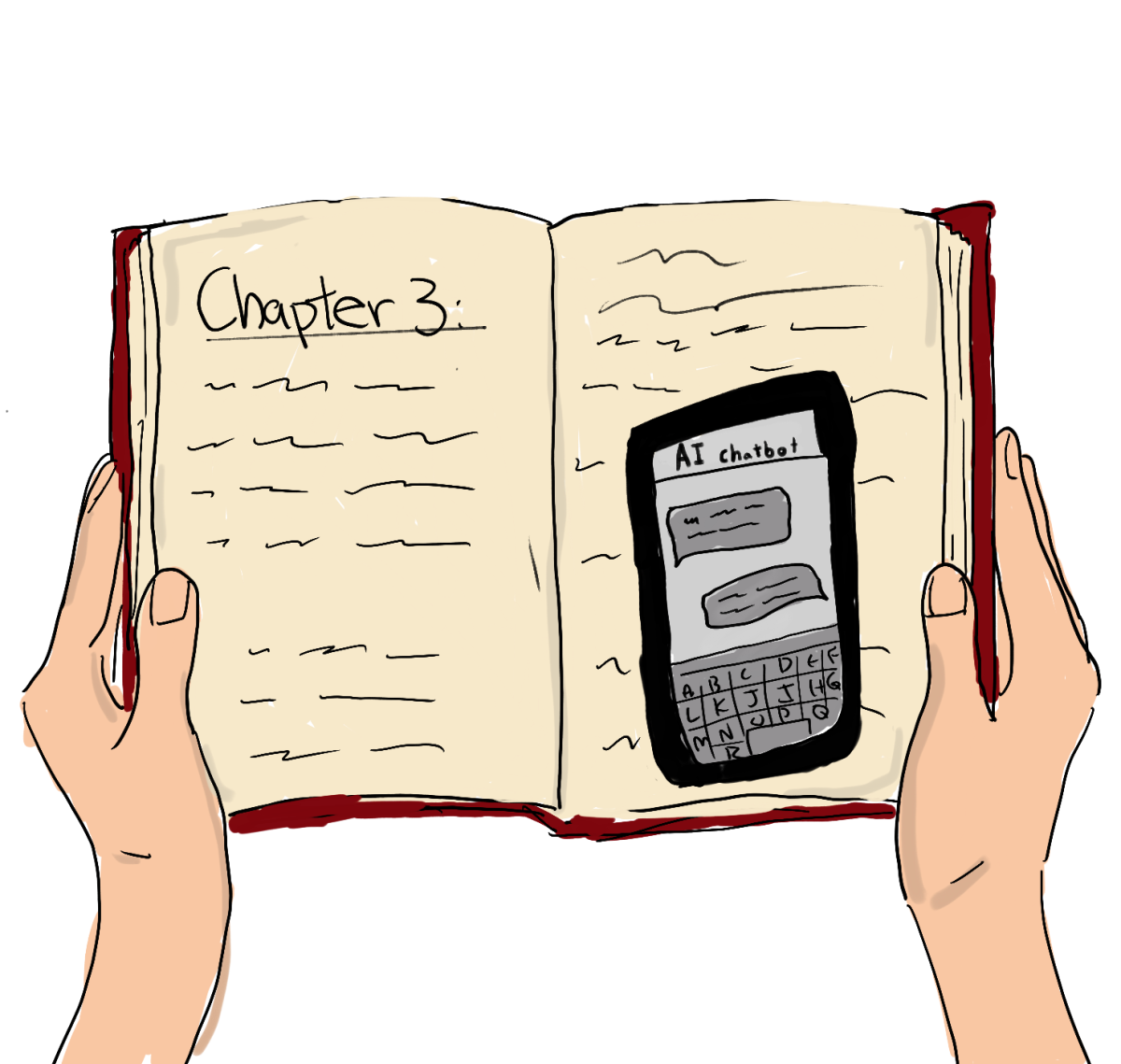
It’s fall at the Upper School, and Aidan Elson ’27 has just finished an at home writing assignment. Just before navigating to the student portal to submit, he runs his work through a Generative Artificial Intelligence (GenAI) site, prompting it to check for double spaces, typos or any other minor mistakes. Just as he is about to enter his query into the chatbot, he hesitates, reminded of recent instances of students getting caught writing essays with AI. He reminds himself, however, that this type of AI use is academically ethical, and continues. Elson said AI can be a useful tool when used correctly and honestly.
“I don’t feel AI is making it harder to think on my own,” Elson said. “With AI, you can spend more time focusing on the aspects of work that you should put effort and thought into over the things that just are time consuming without requiring much thinking, meaning you actually get to do more thinking overall. AI is good at formatting things and presenting structure, but it’s not very good at creating new ideas or content. For example, it is useful for proofreading a long essay to make sure there are no grammatical errors, but not in creating originality in ideas. The little systematic routines that would take so much time to do, AI can get done fast.”
85% of the school’s students report using AI for schoolwork and assignments, according to a poll conducted by The Chronicle. Turner said she worries AI misuse may undermine the purpose of literary education.
“I am not by any means an anti-technology teacher, but what we as teachers are trying to replicate in the age of AI is not just old-fashioned, but important,” Turner said. “Critical thinking is, by nature, a struggle, but learning to struggle in a school environment is meant to help you to know how to struggle once you’re out in the ‘real world.’ What worries me the most is I am finding some, not all, students give up really quickly and turn to AI. If a system is thinking for you, those challenging pain points are now eliminated, and it feels like our understanding of what English education is for is going to need to change.”
The percentage of high school students using GenAI for schoolwork increased from 79% to 84% between January and May of 2025, according to a study conducted by the College Board organization. Senior Prefect Sarah Anschell ’26 said access to AI has the potential to create a more effectively equitable education environment.
“As with anything, there are positives and negatives,” Anschell said. “On the positive side, so many of my classmates, myself included, are able to use AI in place of a tutor which I think levels the playing field in a really meaningful way at school. While some people have access to tutors, others don’t, so the fact that everybody’s able to go home and get one on one instructions step by step is super meaningful.
With any tool, there are gonna be people who exploit it and use it to cut corners, and that’s unfortunate, but I do think that there are many impactful benefits to AI.”
Head of Upper School Beth Slattery said that AI has the potential to benefit academics if implemented properly.
“The school is starting to recognize that AI has become woven into the fabric of our lives and will be for the rest of our lives,” Slattery said. “It’s not going away. We need to adapt, but I don’t think adapting should just focus on stopping students from cheating. It should be focused on finding ways to use AI to enhance learning. This subject is going to be a large part of our professional development meeting in preparation for next school year and will be a primary focus moving forward.”
Turner said access to AI has rapidly changed methods of academic dishonesty on campus.
“When I started teaching, we used to do lessons on plagiarism,” Turner said. “They were a very regular part of the curriculum and to have seen the evolution of academic dishonesty go from copying out of books to a system thinking for you and writing for you is very extreme.”
Nelson LaBombard ’27 said AI has the potential to strengthen academics if implemented correctly.
“AI will change our definition of education,” LaBombard said. “I’m sure that the school will eventually find ways where we can utilize AI to help with learning, which could enhance the academic world. AI can be like a great tool for critical thinking, and I think that an acceptable use of AI is as a pure tutor. For example, I took a class that allowed peer review of essays. I think that AI could also be a good tool for review in terms of giving broad suggestions and acting as a tutor for your writing, which I feel should be acceptable.”
Recently, AI-generated actress Tilly Norwood debuted at the Zurich Film Festival, immediately receiving backlash from unions such as the Screen Actors Guild – American Federation of Television and Radio Artists (SAG-AFTRA) according to Forbes. Isla Saperstein ’27, who aspires to be an actress, said her work in school theater impacts her perception of the rise of AI.
“I’ve learned that what makes art art is the human creation behind it,” Saperstein said.“AI can replicate art that is digestible and that people enjoy, but it can’t make innovative, artistic choices. In theater, for example, so much of the nuance is from the actor’s interpretation of a character. That allows people to connect with other people and stories that they’re not familiar with, and without that human aspect there will be less connection with the viewers. I feel this also with creative writing assignments. It’s valuable to learn how to write effectively and use your voice.”
LaBombard said AI could hinder students’ motivation to innovate creatively moving forward.
“A major drawback is that AI is removing creativity in a lot of cases,” LaBombard said. “With so many people relying on AI to do certain things, not only are they losing their creative skills, but also their own problem-solving skills. There are certain ways that people use AI where it can be problematic. This is not to say that there aren’t ways where AI can augment your critical thinking process, but lack of creativity when used incorrectly is definitely a disadvantage.”
Turner said AI has redefined the purpose of challenging academics.
“I know from my own education and my own early teaching years that students are able to grapple with difficult texts and experience that healthy initial struggle of critical thinking, during which it’s just them, the book, a dictionary, some historical context and a teacher,” Turner said.“I do see some students doing that healthy brain building and really being proud when they come into a writing assessment with a number of ideas in their head. However, a lot of students I’ve talked to this year admit that they turn really quickly to AI to have it generate possible prompts and analytical points, quiz questions and quotations.”
Anschell said AI has inevitably impacted the way many at the school conduct their work.
“From my perspective, because AI has become integrated in so many different things, Google for example, the temptation now for students to use it is higher than ever,” Anschell said. “I also feel that when students feel like their teachers are using AI in some part of the teaching process, that only increases that temptation further.”
Turner said while she understands the appeal of AI, it can potentially undermine the goals of teachers at the school.
“Of course, I get it,” Turner said. “Those early phases of literary analysis are so hard, but it’s that part, that hard critical thinking part, that we’re here to support. The way that this has impacted academic integrity is somewhat demoralizing for teachers, but more importantly, it mostly just worries us that students are turning to AI because they don’t have that muscle memory or confidence to form independent ideas.”
